
Before you start
Agree the study’s quality policy before excluding records. Read each response’s available checks and answers rather than using the score alone.Open a quality result
On Responses, select a row’s Rating or Status. The participant detail displays the available checks and their result: Passed, Failed, or Not evaluated.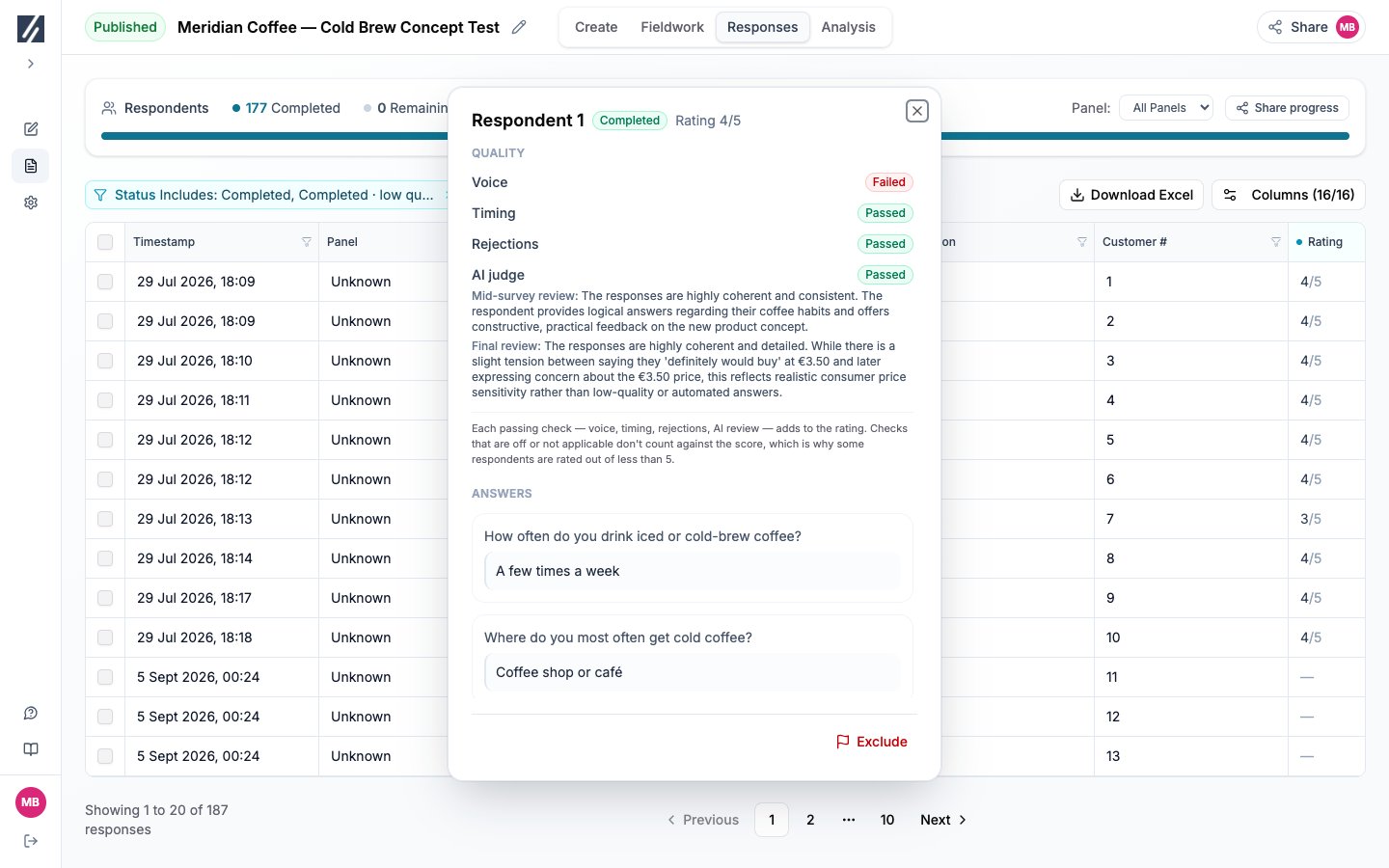
The quality detail explains the checks contributing to the response rating and keeps the participant's answers below them.
Only applicable, enabled checks contribute to the displayed maximum. With all checks active, a response requires three of five points. A hard failure from the coherence review can set the response aside independently of the total score.
A low-quality completion remains available for review but is excluded from completed totals, charts, crosstabs, weighting, and reports. It does not consume a quota cell.
Read a quality stop
For Stopped for quality, open the status to read Why they were stopped. This shows the recorded mid-survey review explanation or rejected answers, rather than a completed-response score. A missing explanation is reported explicitly; do not infer a reason from a blank rating. For completed responses, AI judge can be Partial as well as Passed or Failed. Open the available mid-survey and final review explanations and compare them with the actual answers. Manual exclusion and restoration apply to completed records; they do not turn a stopped session into a completion.Configure quality controls
Open Create → Quotas, panels & links → Quality control. This configuration remains available during live fieldwork.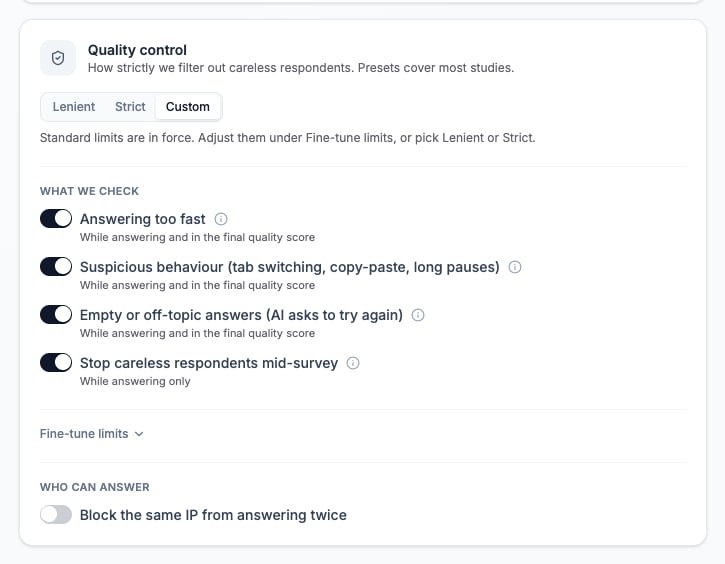
Quality control provides presets, individual checks, thresholds, and duplicate-IP protection for the study.
- Lenient uses passive signals and more permissive thresholds.
- Strict enables the full set with tighter thresholds.
- Custom reflects the current combination of checks and values.
Know which sessions are rated
Test-link sessions and direct invites not associated with a live panel are not given a quality rating or quality stop. A blank Rating for those modes is expected. Live recruited responses are evaluated using the saved quality configuration.Exclude or restore a response
1
Review the complete record
Open the quality detail and read the check results and answers.
2
Exclude it from analysis
Select Exclude, confirm that the entire response should be removed from analysis, and add a reason when needed.
3
Verify the result
The response displays an Excluded indicator and is removed from the analysis population.
4
Restore it if required
Reopen the detail and select Restore respondent.
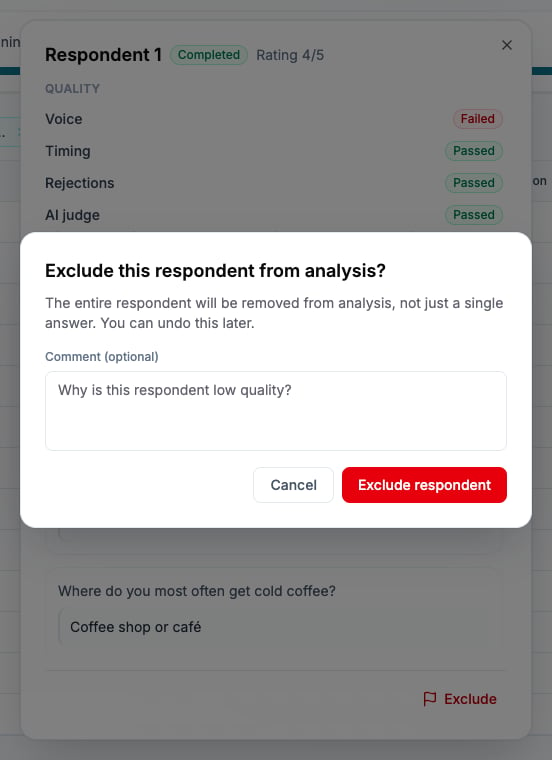
The exclusion confirmation applies to the whole respondent and records an optional reason.
Understand participant-facing checks
An answer submitted below the active speed threshold can be rejected with You answered too fast. The participant remains on the question and can answer again. The rejection contributes to the Rejections result. When mid-survey review is enabled and the available answers meet its stop condition, the session ends with Stopped for quality. Configure Quality Stopped Redirect URL when provider traffic must return to a specific outcome page.Review quality during fieldwork
During the first live responses:- Compare completion, screen-out, and quality-stop counts by panel.
- Sort completed responses by Rating and Duration.
- Read a selection of open-ended answers and recordings.
- Check whether one question produces repeated rejections or abandonment.
- Adjust only settings that reflect the agreed quality policy and document any live change.