> ## Documentation Index
> Fetch the complete documentation index at: https://support.deepfield-ai.com/llms.txt
> Use this file to discover all available pages before exploring further.
# Translate your survey
> Add languages, review each translation against the source, and keep translations current after edits.
Translations are managed from the questionnaire builder. The source language remains the reference version, while each target language has its own editable draft and version history.
## Before you start
Save the source questionnaire and choose the languages required for fieldwork. Prepare localized consent wording separately where the panel needs it.
## Add a language
In **Create**, open the builder view menu and select **Translations**. The language bar appears above the questionnaire.
Select **Add language**, tick one or more languages, and confirm. Translation begins for the questionnaire content available at that time.
Keep the study open or return later. Translation continues on the server. The language bar shows progress for each language.
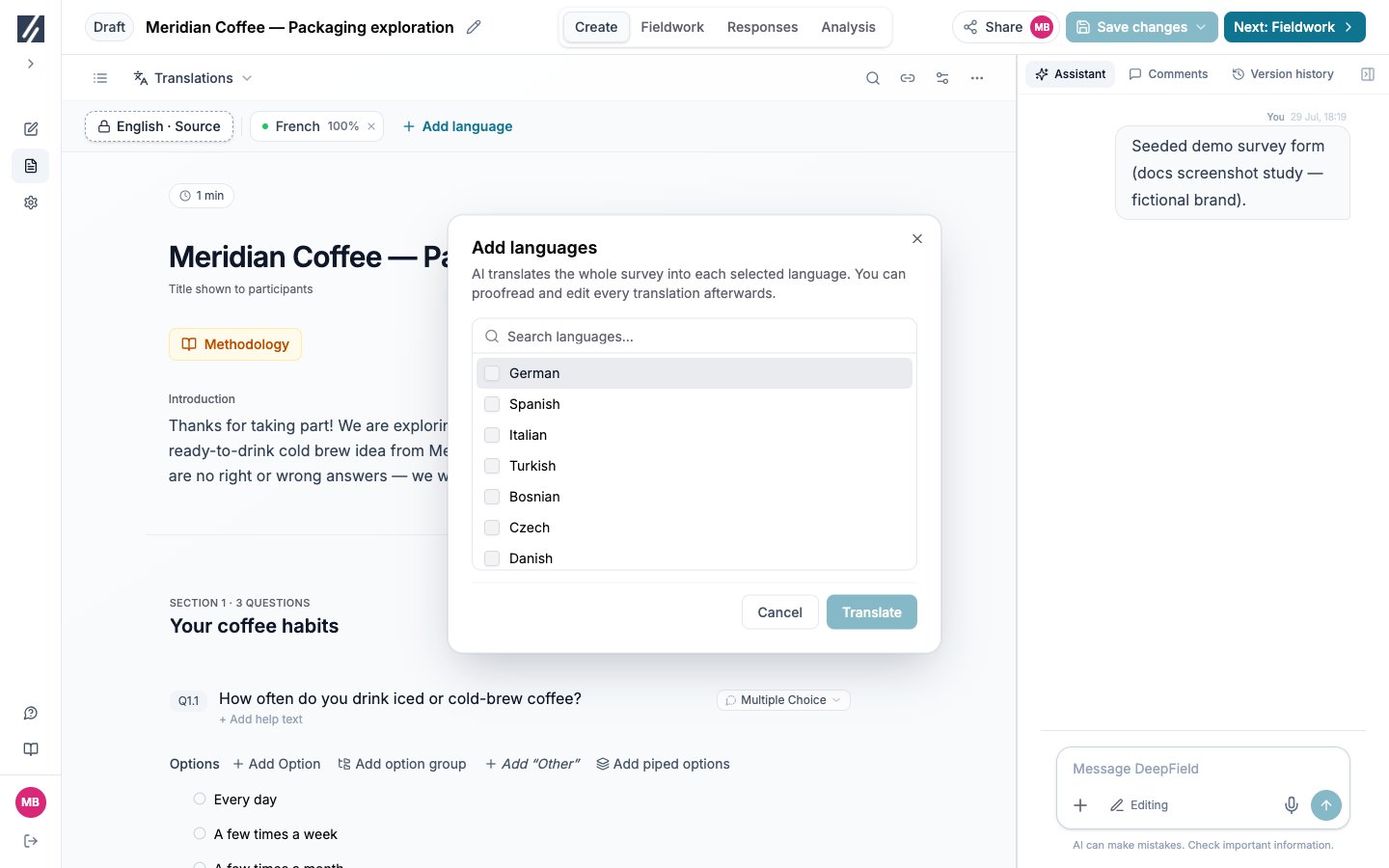 Question text, help text, answer options, matrix rows, introductions, section titles, concepts, and participant-facing custom-renderer text are translated. Custom-renderer source code is copied without translation.
## Review a translation
Select a target language in the language bar. The proofing view displays the editable translation beside the read-only source.
Question text, help text, answer options, matrix rows, introductions, section titles, concepts, and participant-facing custom-renderer text are translated. Custom-renderer source code is copied without translation.
## Review a translation
Select a target language in the language bar. The proofing view displays the editable translation beside the read-only source.
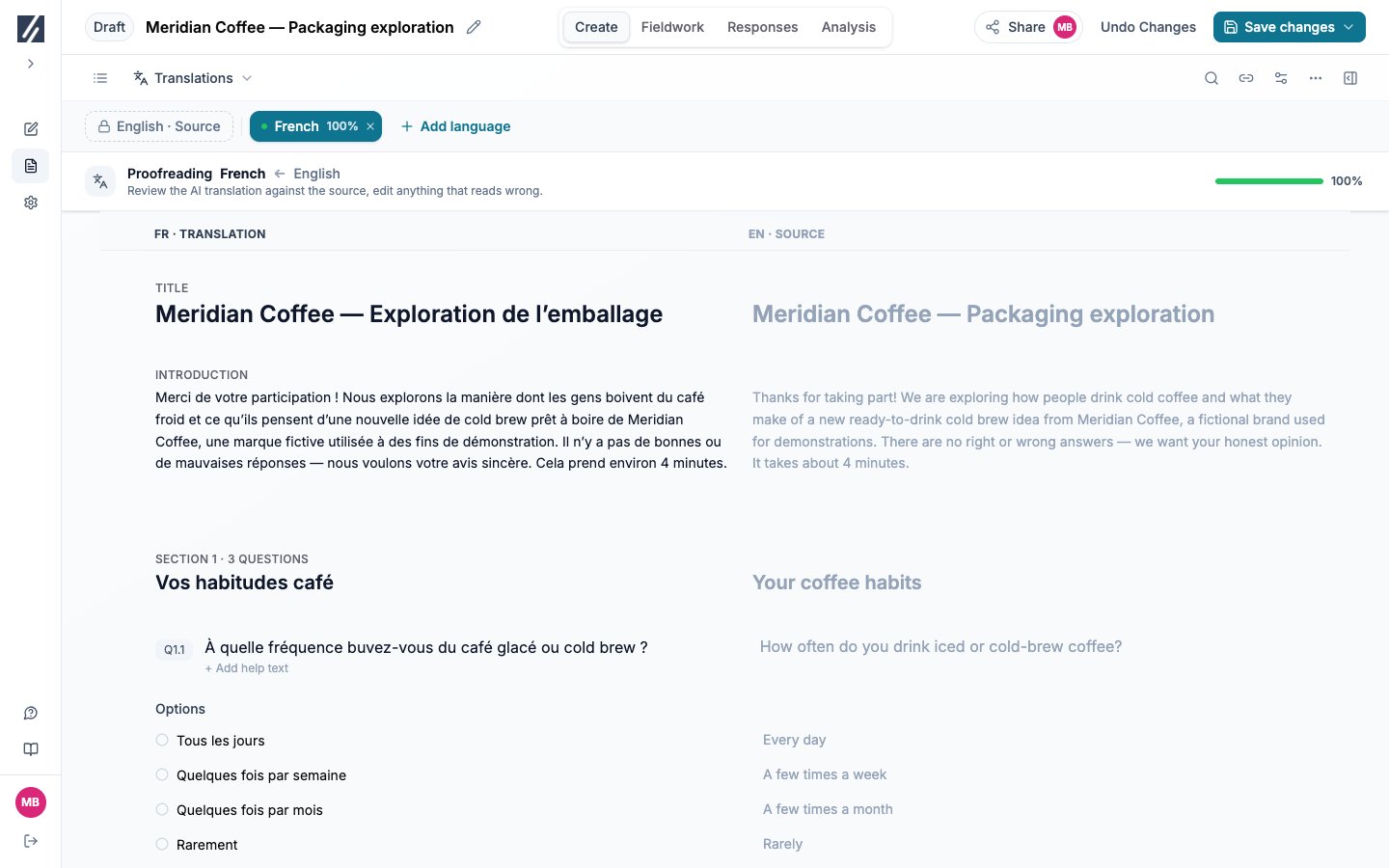 Review the complete participant journey rather than only the question headings:
* Introduction and section transitions.
* Question text, help text, and validation messages.
* Answer options, group headers, and Other labels.
* Piped wording in the routes where each source answer is present.
* Concept titles and media descriptions.
* Text used by custom-code questions.
Edit the translated field directly. Open **Translation history** if you need to compare or restore an earlier saved version of that language.
## Preview a target language
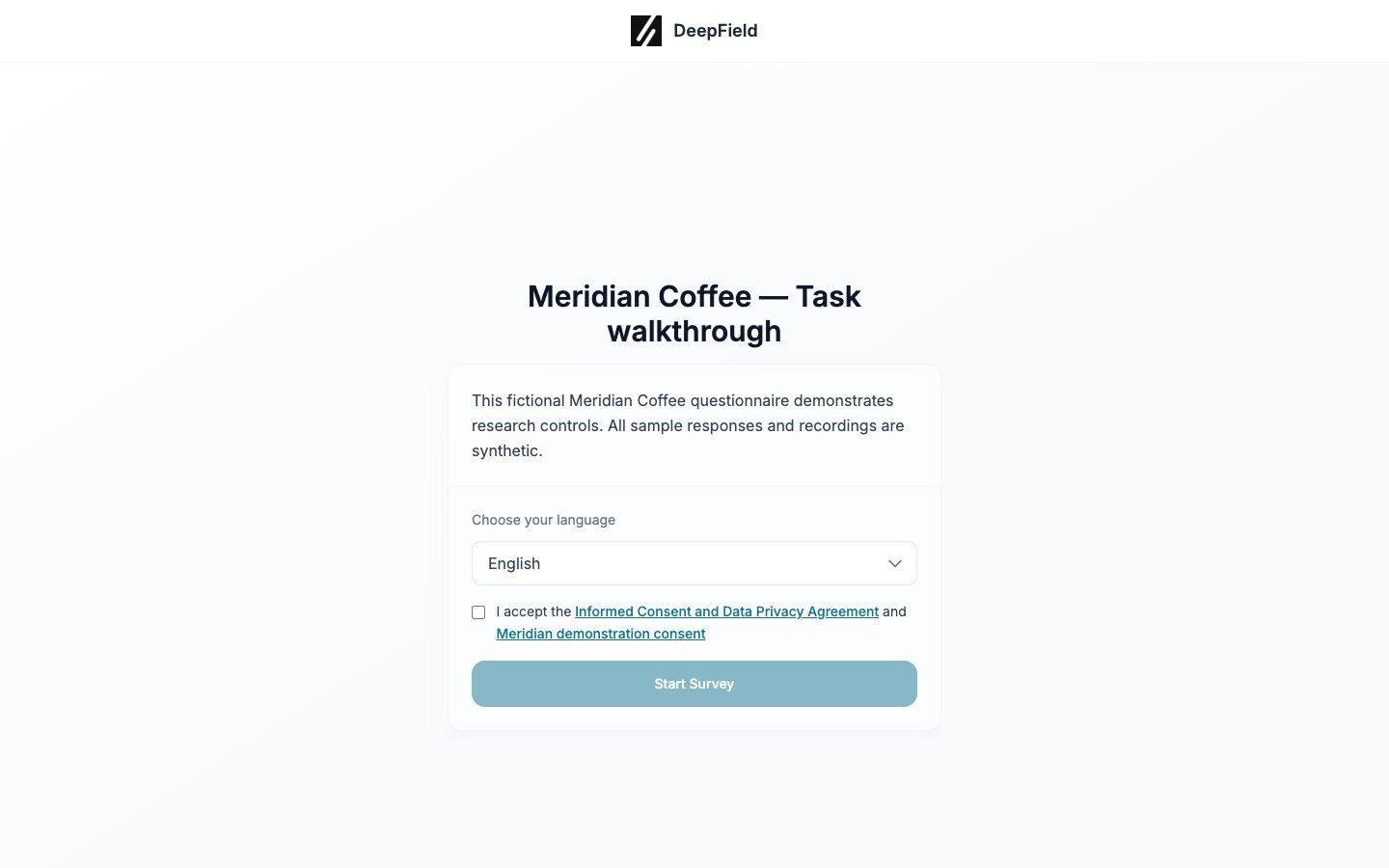
Open **Test**, generate or open the test link, and choose the target language using the participant language selector. Complete routes containing conditional, piped, concept, or custom-code content.
The initial language can also come from the invite URL. If the requested language is unavailable, the source language is used.
Review the complete participant journey rather than only the question headings:
* Introduction and section transitions.
* Question text, help text, and validation messages.
* Answer options, group headers, and Other labels.
* Piped wording in the routes where each source answer is present.
* Concept titles and media descriptions.
* Text used by custom-code questions.
Edit the translated field directly. Open **Translation history** if you need to compare or restore an earlier saved version of that language.
## Preview a target language
Open **Test**, generate or open the test link, and choose the target language using the participant language selector. Complete routes containing conditional, piped, concept, or custom-code content.
The initial language can also come from the invite URL. If the requested language is unavailable, the source language is used.
 ## Update a translation after editing the source
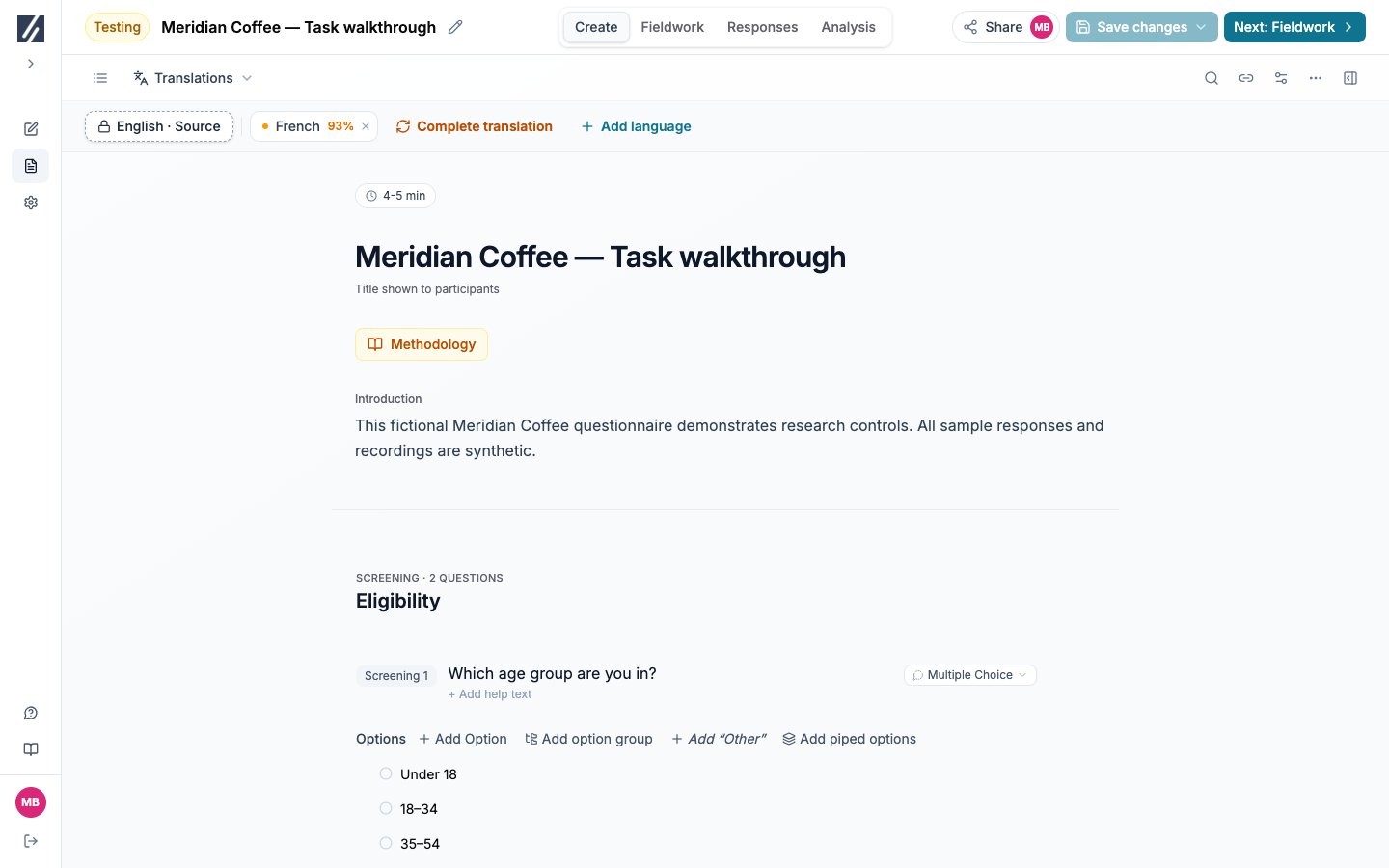
Editing source-language content marks affected translations as out of date. Open **Translations** and select the language carrying the update indicator.
Use **Complete translation** to generate updates for the changed source fields. Review the changed target fields, make any required edits, and save them.
Completing an update does not replace target-language edits unrelated to the changed source fields. Review the change markers before saving to confirm the intended wording remains.
## Update a translation after editing the source
Editing source-language content marks affected translations as out of date. Open **Translations** and select the language carrying the update indicator.
Use **Complete translation** to generate updates for the changed source fields. Review the changed target fields, make any required edits, and save them.
Completing an update does not replace target-language edits unrelated to the changed source fields. Review the change markers before saving to confirm the intended wording remains.
 ## Understand publication requirements
**Publish** is unavailable while any selected language is incomplete or out of date. Return to each marked language, complete its update, review it, and save the translation.
For a custom-code question, also open the renderer's locale preview. Named values under **Advanced — inputs & text** enter the translation workflow. The code itself remains the same across languages, so layouts must accommodate longer text.
## Troubleshooting
Leave the study and reopen it to refresh the server status. If the same language still shows no progress, contact support with the study name and target language.
Open **Translations** and inspect every language pill. Select each marked language, run **Complete translation**, review the updated fields, and save.
Open **Custom-built question → Advanced — inputs & text**. Put short or explicitly managed participant labels in named text values, complete the translation again, and verify the locale in Preview and the test link.
Confirm the language is complete, then choose it from the participant language selector or verify the language value supplied in the invite URL.
## Check the result
Every selected language is complete and saved. In a test link, verify its introduction, options, routing, piped wording, consent text, and custom-interface labels before publishing.
Choose the output language separately in the [analysis plan](/analysis/analysis-plan). Translating the questionnaire does not change the language of an existing analysis.
## Related
* [Edit and save your survey](/building-your-study/survey-editor)
* [Choose and configure question types](/building-your-study/question-types)
* [Test and publish a study](/recruiting/testing-publishing)
* [Troubleshooting and FAQ](/troubleshooting)
## Understand publication requirements
**Publish** is unavailable while any selected language is incomplete or out of date. Return to each marked language, complete its update, review it, and save the translation.
For a custom-code question, also open the renderer's locale preview. Named values under **Advanced — inputs & text** enter the translation workflow. The code itself remains the same across languages, so layouts must accommodate longer text.
## Troubleshooting
Leave the study and reopen it to refresh the server status. If the same language still shows no progress, contact support with the study name and target language.
Open **Translations** and inspect every language pill. Select each marked language, run **Complete translation**, review the updated fields, and save.
Open **Custom-built question → Advanced — inputs & text**. Put short or explicitly managed participant labels in named text values, complete the translation again, and verify the locale in Preview and the test link.
Confirm the language is complete, then choose it from the participant language selector or verify the language value supplied in the invite URL.
## Check the result
Every selected language is complete and saved. In a test link, verify its introduction, options, routing, piped wording, consent text, and custom-interface labels before publishing.
Choose the output language separately in the [analysis plan](/analysis/analysis-plan). Translating the questionnaire does not change the language of an existing analysis.
## Related
* [Edit and save your survey](/building-your-study/survey-editor)
* [Choose and configure question types](/building-your-study/question-types)
* [Test and publish a study](/recruiting/testing-publishing)
* [Troubleshooting and FAQ](/troubleshooting)