> ## Documentation Index
> Fetch the complete documentation index at: https://support.deepfield-ai.com/llms.txt
> Use this file to discover all available pages before exploring further.
# Set quotas
> Define sample targets and caps from screening answers, including grouped and nested quota cells.
Quotas control how qualifying responses are distributed across selected screening answers. Each panel has its own quota configuration in **Quotas, panels & links**, with live fill counts displayed on **Fieldwork**.
## Before you start
Save eligible Multiple Choice screening questions and decide the target and optional cap for every planned cell.
## Create a quota
In **Create**, open the builder view menu, select **Quotas, panels & links**, and choose the panel to configure.
In **Quotas**, select **Add quota** and choose a Multiple Choice screening question. Its selectable options become quota rows.
Use **Min** for the target and **Max** for the intake cap. Leave Max empty only when responses may continue past the target while the panel remains open.
Resolve any validation message, save the form, and confirm the cells on Fieldwork.
Min does not stop intake. Max closes the cell to new qualifying participants:
| Configuration | Fieldwork behavior |
| ---------------- | ----------------------------------------------------------------- |
| Min 100, no Max | The cell can exceed 100 while the panel still requires responses. |
| Min 100, Max 100 | Intake for the cell stops at 100. |
| Min 100, Max 120 | The target is 100 and up to 20 additional responses can enter. |
Max must be equal to or greater than Min and cannot exceed the allowed panel total. To exclude an answer entirely, use a screening rule instead of setting Max to zero.
## Create nested quota cells
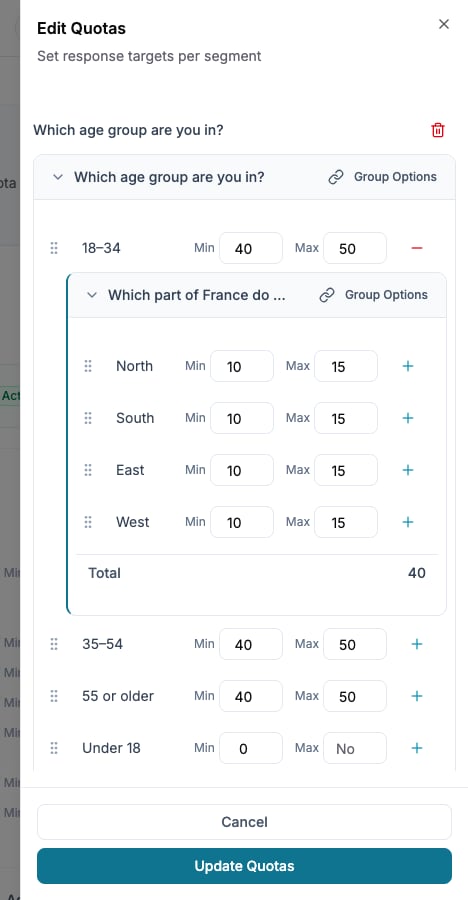
Use nesting to cross one eligible screening question with another, such as region within age.
Open its actions and select **Add nested quota**.
Select the screening question that defines the nested rows.
Apply the structure to the selected parent option or to all options at that level.
Review the cell structure, select **Add Nested Quota**, and enter Min and Max for each resulting cell.
Check whether every combined cell is recruitable. Two individually common answers can form a small intersection.
 ## Group options under one target
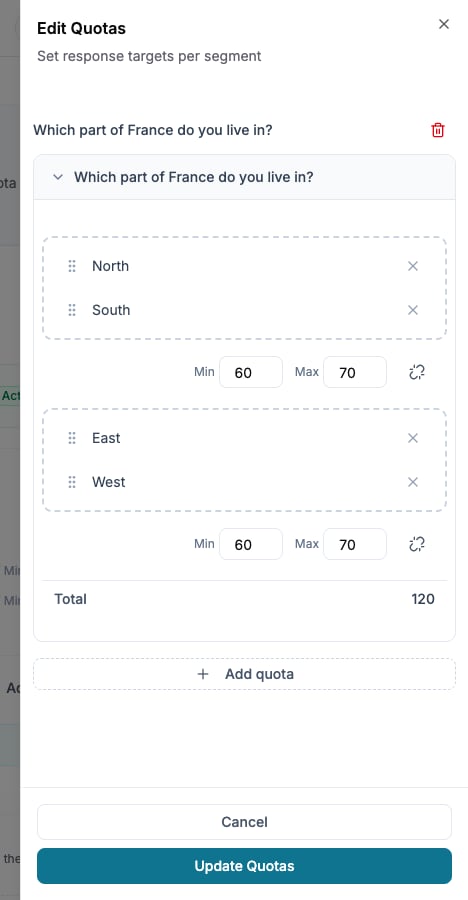
Select **Group Options** and choose at least two options, or drag one option onto another. The combined row receives one target and cap. Use **Ungroup** to restore separate rows.
Grouped options cannot contain nested quotas. Keep options separate when the group also needs another quota dimension.
## Group options under one target
Select **Group Options** and choose at least two options, or drag one option onto another. The combined row receives one target and cap. Use **Ungroup** to restore separate rows.
Grouped options cannot contain nested quotas. Keep options separate when the group also needs another quota dimension.
 ## Monitor quota fills
Open **Fieldwork** and find **Recruitment progress**. Each row compares the current count with Min and, when set, Max. Review individual cells as well as the total panel progress.
When a cell reaches Max, later participants who match it end as quota exceeded. The panel's **Quota Exceeded Redirect URL** determines whether they return to a provider or see the built-in end screen.
## Troubleshooting
Check whether **Max** is empty or higher than **Min**. Min measures the target; only Max stops additional intake.
Compare it with the screening rules, then review any nested dimensions. The UI identifies direct screener conflicts; a narrow combination may also require a feasibility decision.
Add and save a Multiple Choice question in the Screening section. Open-ended, numeric, custom-code, or main-questionnaire fields are not eligible quota sources.
## Check the result
Reopen the saved quota and compare every cell with the sample plan. In fieldwork, distinguish progress toward Min from closure at Max, including nested and grouped cells.
## Related
* [Screen participants](/recruiting/screening-questions)
* [Configure your audience](/recruiting/panels-demographics)
* [Choose a sample size](/recruiting/choosing-a-sample-size)
* [Test and publish a study](/recruiting/testing-publishing)
## Monitor quota fills
Open **Fieldwork** and find **Recruitment progress**. Each row compares the current count with Min and, when set, Max. Review individual cells as well as the total panel progress.
When a cell reaches Max, later participants who match it end as quota exceeded. The panel's **Quota Exceeded Redirect URL** determines whether they return to a provider or see the built-in end screen.
## Troubleshooting
Check whether **Max** is empty or higher than **Min**. Min measures the target; only Max stops additional intake.
Compare it with the screening rules, then review any nested dimensions. The UI identifies direct screener conflicts; a narrow combination may also require a feasibility decision.
Add and save a Multiple Choice question in the Screening section. Open-ended, numeric, custom-code, or main-questionnaire fields are not eligible quota sources.
## Check the result
Reopen the saved quota and compare every cell with the sample plan. In fieldwork, distinguish progress toward Min from closure at Max, including nested and grouped cells.
## Related
* [Screen participants](/recruiting/screening-questions)
* [Configure your audience](/recruiting/panels-demographics)
* [Choose a sample size](/recruiting/choosing-a-sample-size)
* [Test and publish a study](/recruiting/testing-publishing)