> ## Documentation Index
> Fetch the complete documentation index at: https://support.deepfield-ai.com/llms.txt
> Use this file to discover all available pages before exploring further.
# Review your first completed study
> Turn the first end-to-end study into a stronger process for the next one.
After the findings have been shared, review the full study—from questionnaire design through reporting. The goal is to record what should be repeated, changed, or investigated before your next launch.
 ## Before you start
Bring the delivered files, final sample, fieldwork notes, and access list after findings have been shared.
## Review the sample
Compare the planned and achieved sample. Focus on the subgroups that appeared in the final conclusions, including any that were not central in the original plan.
Ask:
* Did each reported subgroup have a sufficient unweighted base?
* Did screening produce the intended audience?
* Did quotas fill as planned, and where did they constrain collection?
* Did weighting correct a known imbalance without excessive variance?
* Which completed responses were excluded, and why?
Save the final bases and weighting source with the project record.
## Review the questionnaire
Use response distributions, open-text answers, abandonment points, and participant feedback to identify improvements. Note questions that:
* Were interpreted inconsistently
* Produced options with little or no use
* Needed an option that was missing
* Repeated information already collected
* Appeared too early or too late
* Created avoidable routing complexity
* Were difficult to answer on mobile or with media
Do not edit a completed study as a template without preserving the final fielded version. Create the next study separately and apply the documented changes there.
## Review the analysis claims
Take the main statements from the report or deck and trace each one to its chart or source answers. Confirm that:
* Wording matches the population and sample actually studied
* Differences are supported by the base and, where relevant, significance tests
* Weighting is disclosed where it affects interpretation
* Open-text examples represent a theme rather than an isolated response
* Recommendations are clearly separated from measured findings
## Review access and delivery
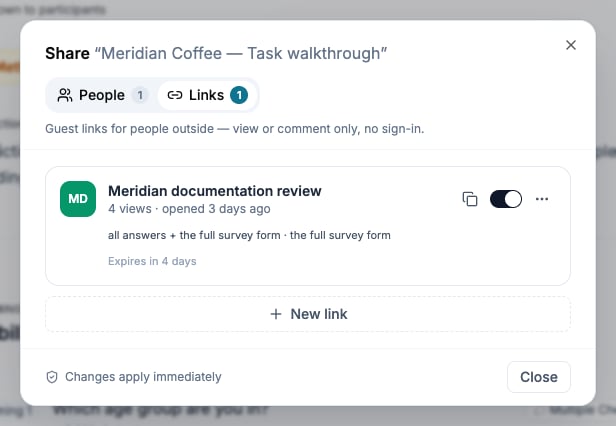
Confirm that workspace membership and study access match current responsibilities. Disable guest links that are no longer needed, extend only those still in use, and check what each active link exposes.
Store the appropriate final deliverables:
* PowerPoint for an editable presentation
* Excel for numeric charts and crosstabs
* Response-level Excel only where access to participant data is justified
## Start the next study with a change log
Create a short list with three headings: **Keep**, **Change**, and **Investigate**. Use it during the next brief and test cycle. This makes the completed study a practical input to the next one instead of relying on memory.
## Check the result
Keep, Change, and Investigate decisions are written down, final deliverables are retained, and active access reflects current responsibilities.
## Related
* [Follow a study from brief to findings](/getting-started/worked-example)
* [Review response quality](/responses/response-quality)
* [Interpret significance](/analysis/reading-significance)
* [Share a study](/sharing/share-your-work)
## Before you start
Bring the delivered files, final sample, fieldwork notes, and access list after findings have been shared.
## Review the sample
Compare the planned and achieved sample. Focus on the subgroups that appeared in the final conclusions, including any that were not central in the original plan.
Ask:
* Did each reported subgroup have a sufficient unweighted base?
* Did screening produce the intended audience?
* Did quotas fill as planned, and where did they constrain collection?
* Did weighting correct a known imbalance without excessive variance?
* Which completed responses were excluded, and why?
Save the final bases and weighting source with the project record.
## Review the questionnaire
Use response distributions, open-text answers, abandonment points, and participant feedback to identify improvements. Note questions that:
* Were interpreted inconsistently
* Produced options with little or no use
* Needed an option that was missing
* Repeated information already collected
* Appeared too early or too late
* Created avoidable routing complexity
* Were difficult to answer on mobile or with media
Do not edit a completed study as a template without preserving the final fielded version. Create the next study separately and apply the documented changes there.
## Review the analysis claims
Take the main statements from the report or deck and trace each one to its chart or source answers. Confirm that:
* Wording matches the population and sample actually studied
* Differences are supported by the base and, where relevant, significance tests
* Weighting is disclosed where it affects interpretation
* Open-text examples represent a theme rather than an isolated response
* Recommendations are clearly separated from measured findings
## Review access and delivery
Confirm that workspace membership and study access match current responsibilities. Disable guest links that are no longer needed, extend only those still in use, and check what each active link exposes.
Store the appropriate final deliverables:
* PowerPoint for an editable presentation
* Excel for numeric charts and crosstabs
* Response-level Excel only where access to participant data is justified
## Start the next study with a change log
Create a short list with three headings: **Keep**, **Change**, and **Investigate**. Use it during the next brief and test cycle. This makes the completed study a practical input to the next one instead of relying on memory.
## Check the result
Keep, Change, and Investigate decisions are written down, final deliverables are retained, and active access reflects current responsibilities.
## Related
* [Follow a study from brief to findings](/getting-started/worked-example)
* [Review response quality](/responses/response-quality)
* [Interpret significance](/analysis/reading-significance)
* [Share a study](/sharing/share-your-work)