> ## Documentation Index
> Fetch the complete documentation index at: https://support.deepfield-ai.com/llms.txt
> Use this file to discover all available pages before exploring further.
# Choose and configure question types
> Select the answer structure participants need, configure its settings, and build a custom question interface when required.
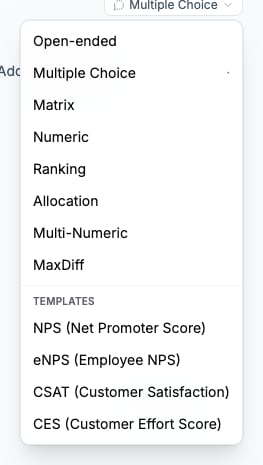
The question type determines the shape of every stored answer. It also controls which validation, logic, chart, and export options are available later. Select the type chip on a question card to change it while the study is editable.
 ## Before you start
Define what each question must measure and how its answer will be analyzed. Choose the type before collecting live responses.
## Select a built-in type
| Type | Participant task | Typical use |
| ------------------- | --------------------------------------------------------- | ---------------------------------------------------------- |
| **Open-ended** | Record or type a free response | Reasons, experiences, explanations, and follow-up probing |
| **Multiple Choice** | Select one or several options | Categories used in filters, routing, quotas, or charts |
| **Matrix** | Answer the same scale or numeric task across several rows | Attribute ratings or repeated measures with a shared scale |
| **Numeric** | Enter or select one number | Age, spend, counts, prices, and rating scales |
| **Ranking** | Put items in order | Relative preference or priority |
| **Allocation** | Divide a fixed total among items | Share of budget, time, points, or attention |
| **Multi-Numeric** | Enter one number for every item | Quantities that do not need to sum to a fixed total |
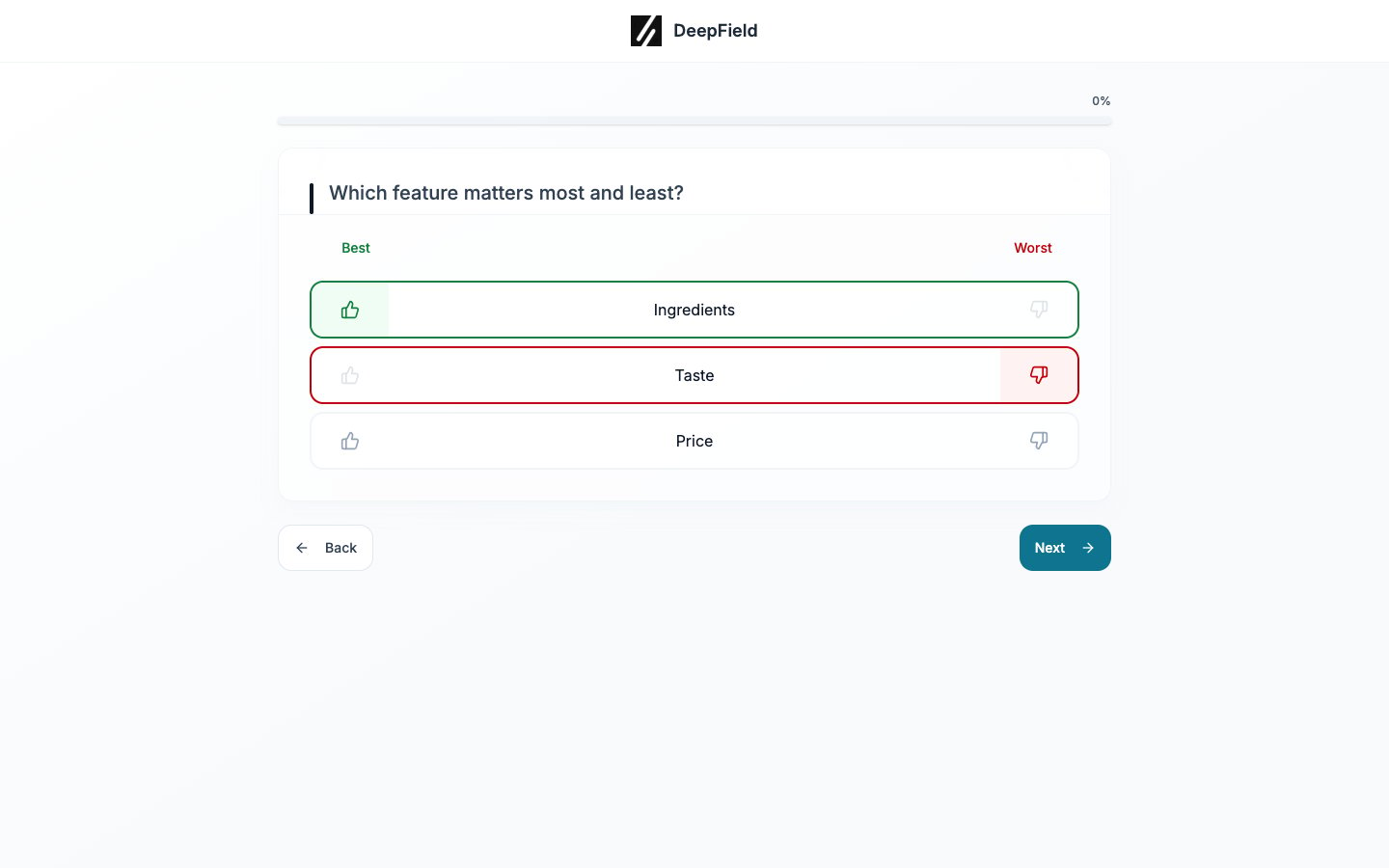
| **MaxDiff** | Select the best and worst items across repeated tasks | Discriminating among a larger set of items |
MaxDiff is not available in the Screening section.
## Configure settings shared across types
Use **Add help text** for participant instructions that belong directly under the question. Type **@** in question text, help text, or an option label to insert an earlier answer or variable.
Open **⋯** to configure logic, answer validation, media, display settings, or a custom renderer. The **Templates** group in the type picker can create NPS, eNPS, CSAT, or CES wording and scales. Applying a template replaces the current question configuration after confirmation.
## Configure Open-ended questions
Set the number of **Follow-up questions** from none to five. **Follow-up instructions** can focus the assistant on specific parts of the participant's response.
Use format validation for an email address, phone number, postal code, date, number, letters-only response, or a character range. Write the correction message the participant should see when the response does not pass.
**Preferred input type** controls whether the question follows the study default or requests Audio, Video, or Text. The study-level **Response Mode** takes precedence:
| Response Mode | Participant experience |
| ------------------ | ------------------------------------------------------------------------------- |
| **Audio Required** | Microphone permission and audio recording are required; no text route is shown. |
| **Audio Optional** | The participant chooses microphone or text. |
| **Text Only** | The question uses text without a recording choice. |
Open-ended answers advance according to the participant response flow. If participants need to correct an earlier answer, enable the study's back-navigation setting and verify it in a test link.
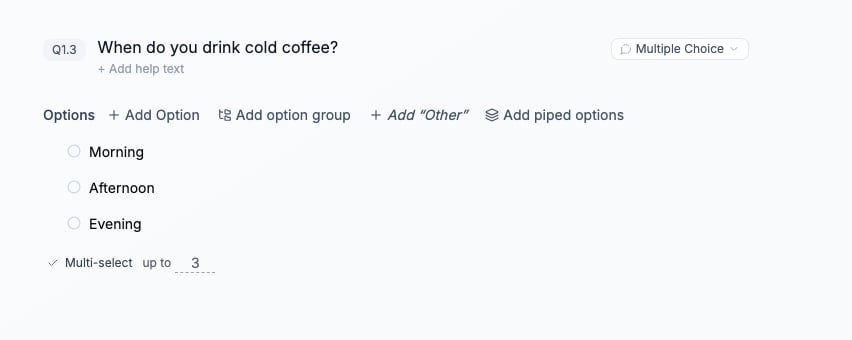
## Configure Multiple Choice questions
Add options individually, reorder them, or insert option groups as non-selectable headers.
* **Multi-select** allows several choices.
* **Max Selections** limits a multi-select answer.
* **Add “Other”** adds a write-in option; **Require typed text** makes its text mandatory.
* **Randomize Order** changes the option order per participant.
* The display-count setting draws only the specified number of randomized options.
Each option's settings can make it exclusive, turn it into a group header, add a condition, or attach media. An exclusive option clears other selections and is suitable for choices such as “None of these.”
## Before you start
Define what each question must measure and how its answer will be analyzed. Choose the type before collecting live responses.
## Select a built-in type
| Type | Participant task | Typical use |
| ------------------- | --------------------------------------------------------- | ---------------------------------------------------------- |
| **Open-ended** | Record or type a free response | Reasons, experiences, explanations, and follow-up probing |
| **Multiple Choice** | Select one or several options | Categories used in filters, routing, quotas, or charts |
| **Matrix** | Answer the same scale or numeric task across several rows | Attribute ratings or repeated measures with a shared scale |
| **Numeric** | Enter or select one number | Age, spend, counts, prices, and rating scales |
| **Ranking** | Put items in order | Relative preference or priority |
| **Allocation** | Divide a fixed total among items | Share of budget, time, points, or attention |
| **Multi-Numeric** | Enter one number for every item | Quantities that do not need to sum to a fixed total |
| **MaxDiff** | Select the best and worst items across repeated tasks | Discriminating among a larger set of items |
MaxDiff is not available in the Screening section.
## Configure settings shared across types
Use **Add help text** for participant instructions that belong directly under the question. Type **@** in question text, help text, or an option label to insert an earlier answer or variable.
Open **⋯** to configure logic, answer validation, media, display settings, or a custom renderer. The **Templates** group in the type picker can create NPS, eNPS, CSAT, or CES wording and scales. Applying a template replaces the current question configuration after confirmation.
## Configure Open-ended questions
Set the number of **Follow-up questions** from none to five. **Follow-up instructions** can focus the assistant on specific parts of the participant's response.
Use format validation for an email address, phone number, postal code, date, number, letters-only response, or a character range. Write the correction message the participant should see when the response does not pass.
**Preferred input type** controls whether the question follows the study default or requests Audio, Video, or Text. The study-level **Response Mode** takes precedence:
| Response Mode | Participant experience |
| ------------------ | ------------------------------------------------------------------------------- |
| **Audio Required** | Microphone permission and audio recording are required; no text route is shown. |
| **Audio Optional** | The participant chooses microphone or text. |
| **Text Only** | The question uses text without a recording choice. |
Open-ended answers advance according to the participant response flow. If participants need to correct an earlier answer, enable the study's back-navigation setting and verify it in a test link.
## Configure Multiple Choice questions
Add options individually, reorder them, or insert option groups as non-selectable headers.
* **Multi-select** allows several choices.
* **Max Selections** limits a multi-select answer.
* **Add “Other”** adds a write-in option; **Require typed text** makes its text mandatory.
* **Randomize Order** changes the option order per participant.
* The display-count setting draws only the specified number of randomized options.
Each option's settings can make it exclusive, turn it into a group header, add a condition, or attach media. An exclusive option clears other selections and is suitable for choices such as “None of these.”
 ## Configure Matrix questions
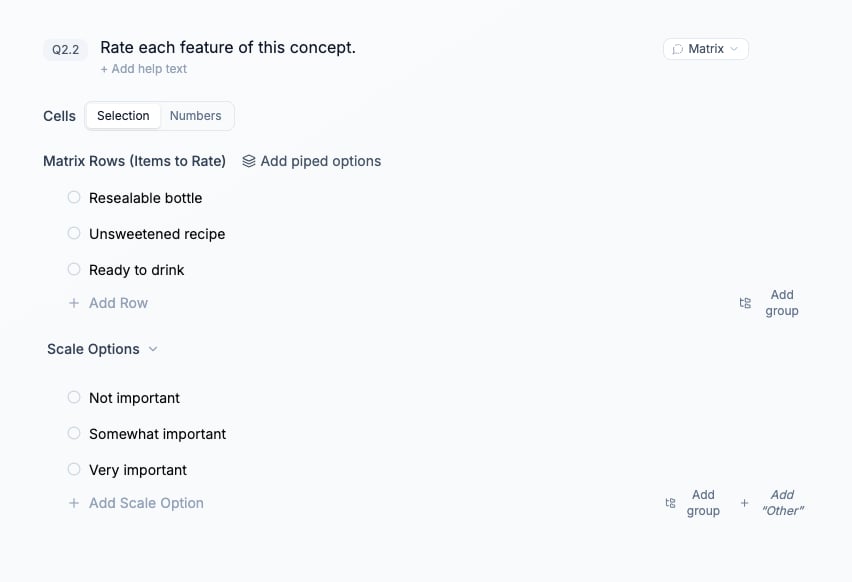
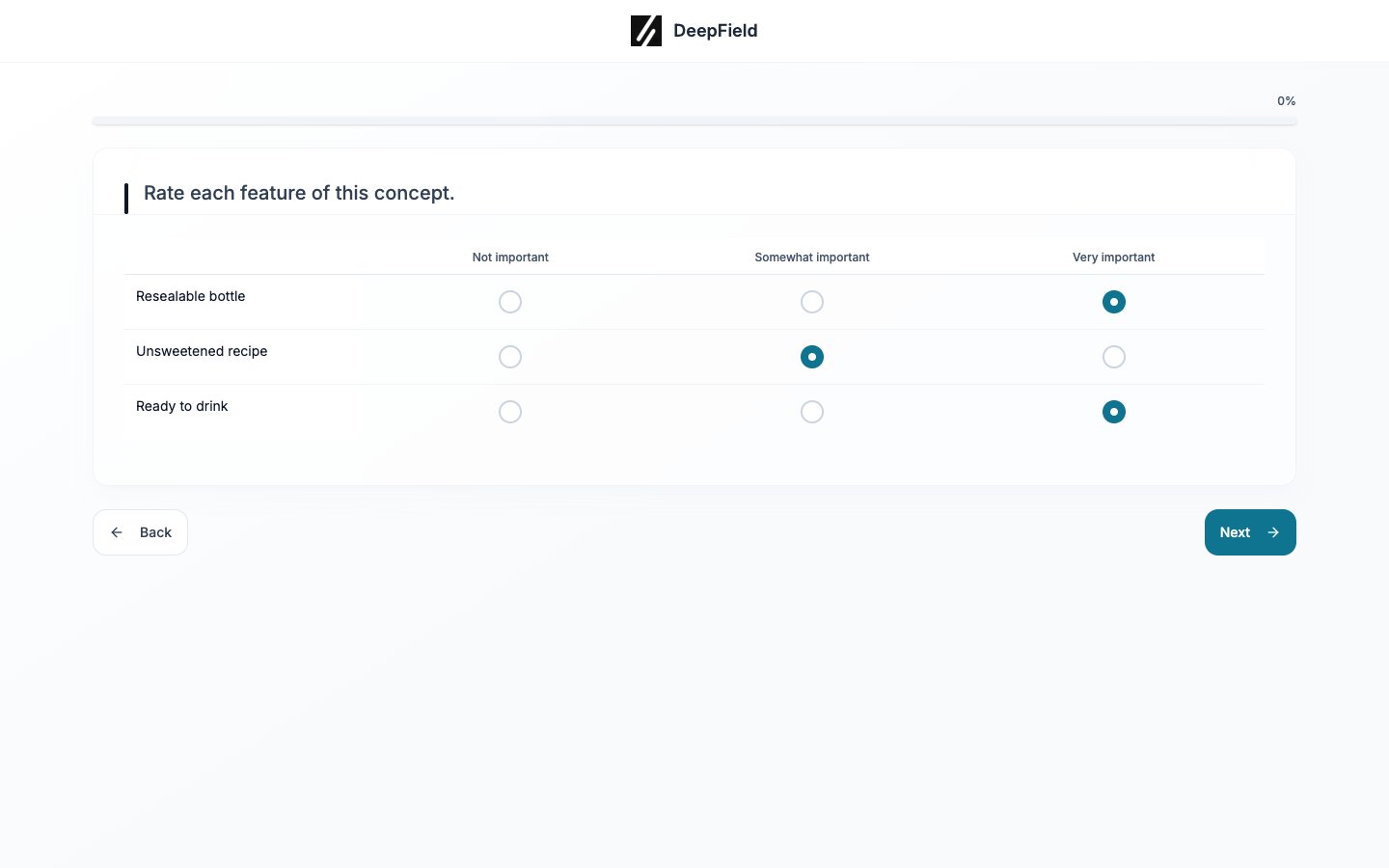
Enter the items to evaluate as rows and the shared answer scale as columns. Choose categorical **Selection** cells or **Numbers**.
Numeric matrices can set a range, show totals, and require each row or column to add to a defined amount. Categorical matrices can permit several selections per row.
The scale can be entered directly or piped from an earlier Allocation or Multi-Numeric question. Piped numeric values can be limited with **Top N** or **Greater than**. Rows can also be randomized or drawn as a subset.
## Configure Matrix questions
Enter the items to evaluate as rows and the shared answer scale as columns. Choose categorical **Selection** cells or **Numbers**.
Numeric matrices can set a range, show totals, and require each row or column to add to a defined amount. Categorical matrices can permit several selections per row.
The scale can be entered directly or piped from an earlier Allocation or Multi-Numeric question. Piped numeric values can be limited with **Top N** or **Greater than**. Rows can also be randomized or drawn as a subset.
 ## Configure Numeric and Multi-Numeric questions
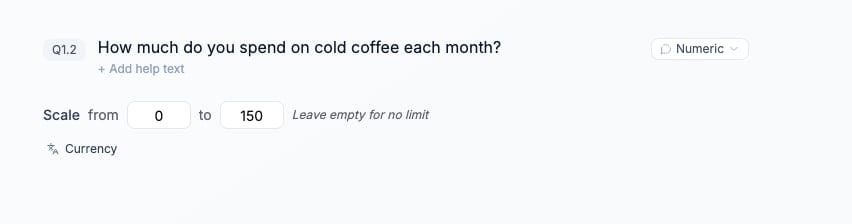
For Numeric, set **Scale Min** and **Scale Max** when the value must fall inside a range. Choose a **Number field** for precise entry or **Slider** for selection along a bounded scale.
**Ask for currency** adds a currency selector. The participant can change the suggested currency. The setting applies to numeric question types and is removed if the question changes to an incompatible type.
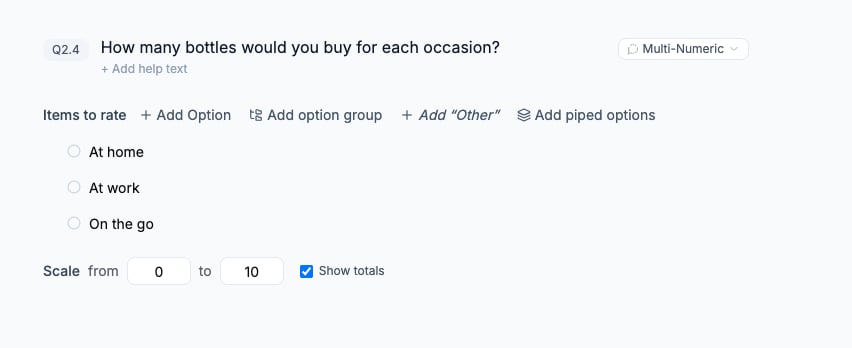
Multi-Numeric uses the same range for a list of items and can display their total. Use Allocation instead when the values must add to a fixed amount.
## Configure Numeric and Multi-Numeric questions
For Numeric, set **Scale Min** and **Scale Max** when the value must fall inside a range. Choose a **Number field** for precise entry or **Slider** for selection along a bounded scale.
**Ask for currency** adds a currency selector. The participant can change the suggested currency. The setting applies to numeric question types and is removed if the question changes to an incompatible type.
Multi-Numeric uses the same range for a list of items and can display their total. Use Allocation instead when the values must add to a fixed amount.
 ## Configure Ranking and Allocation questions
Ranking can require all items or only the top N. It can randomize the starting list and include an Other item.
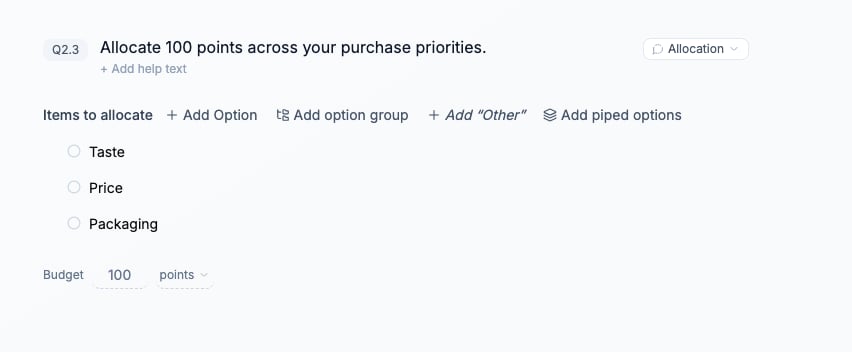
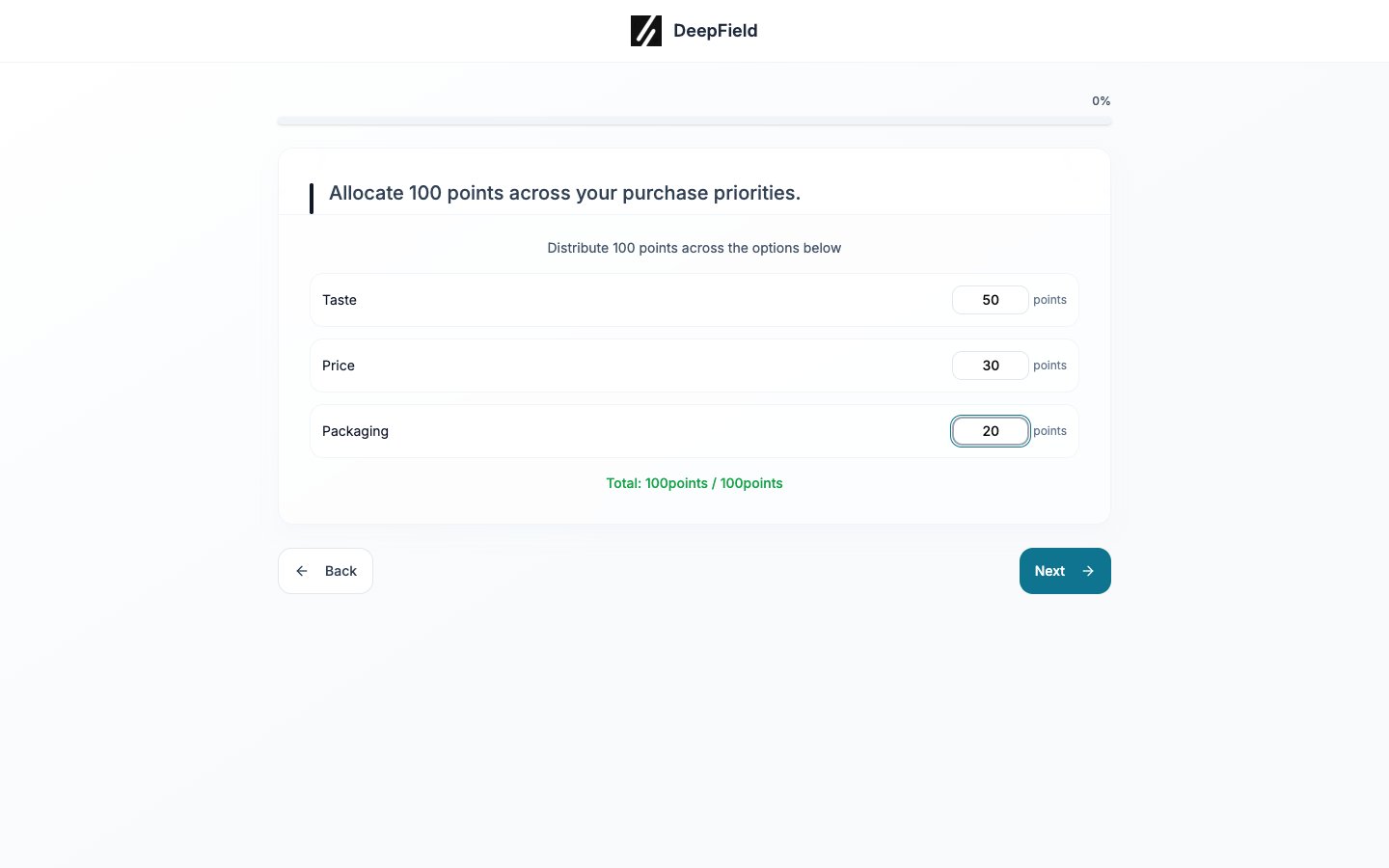
Allocation requires a **Budget** and a unit such as percent, dollars, points, hours, or a custom unit. The participant sees the amount used and remaining, and cannot continue with an invalid total.
## Configure Ranking and Allocation questions
Ranking can require all items or only the top N. It can randomize the starting list and include an Other item.
Allocation requires a **Budget** and a unit such as percent, dollars, points, hours, or a custom unit. The participant sees the amount used and remaining, and cannot continue with an invalid total.
 ## Configure MaxDiff
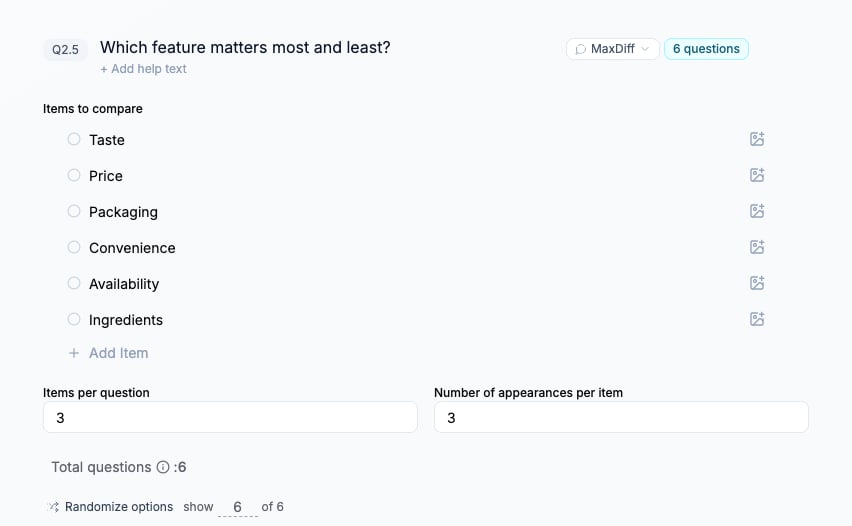
Add the items, then set **Items per question** and **Number of appearances per item**. DeepField calculates the resulting number of tasks.
Use at least four items. The total number of item appearances must divide evenly by the number of items shown in each task. Adjust appearances or task size until the configuration passes validation.
## Configure MaxDiff
Add the items, then set **Items per question** and **Number of appearances per item**. DeepField calculates the resulting number of tasks.
Use at least four items. The total number of item appearances must divide evenly by the number of items shown in each task. Adjust appearances or task size until the configuration passes validation.
 ## Build a custom question interface
Use a custom interface when built-in settings cannot express the participant task. The underlying question type still determines validation, analysis, and typed exports. Follow [Build a custom question interface](/building-your-study/custom-question-interfaces) to define inputs, test the stored value, and save it.
### Ask the assistant to build the renderer
See [the custom-interface procedure](/building-your-study/custom-question-interfaces#ask-the-assistant-to-build-the-renderer).
### Open the renderer editor
See [the custom-interface procedure](/building-your-study/custom-question-interfaces#open-the-renderer-editor).
### Edit the component
See [the custom-interface procedure](/building-your-study/custom-question-interfaces#edit-the-component).
### Match the answer contract
See [the custom-interface procedure](/building-your-study/custom-question-interfaces#match-the-answer-contract).
### Add earlier answers and translatable text
See [the custom-interface procedure](/building-your-study/custom-question-interfaces#add-earlier-answers-and-translatable-text).
### Test and save the renderer
See [the custom-interface procedure](/building-your-study/custom-question-interfaces#test-and-save-the-renderer).
### Understand analysis and export behavior
See [the custom-interface procedure](/building-your-study/custom-question-interfaces#understand-analysis-and-export-behavior).
### Return to the built-in interface
See [the custom-interface procedure](/building-your-study/custom-question-interfaces#return-to-the-built-in-interface).
### Troubleshoot a renderer
See [the custom-interface procedure](/building-your-study/custom-question-interfaces#troubleshoot-a-renderer).
## Check the result
Save the questionnaire. Test typical, boundary, and incomplete answers for each configured type, then inspect the stored answers in Responses. Check mobile rendering and any dependent routing or piping.
## Related
* [Configure logic and piping](/building-your-study/advanced-logic)
* [Add stimuli and concepts](/building-your-study/stimulus-materials)
* [Translate your survey](/translations/multilingual-studies)
* [Export response data](/responses/exporting-data)
## Build a custom question interface
Use a custom interface when built-in settings cannot express the participant task. The underlying question type still determines validation, analysis, and typed exports. Follow [Build a custom question interface](/building-your-study/custom-question-interfaces) to define inputs, test the stored value, and save it.
### Ask the assistant to build the renderer
See [the custom-interface procedure](/building-your-study/custom-question-interfaces#ask-the-assistant-to-build-the-renderer).
### Open the renderer editor
See [the custom-interface procedure](/building-your-study/custom-question-interfaces#open-the-renderer-editor).
### Edit the component
See [the custom-interface procedure](/building-your-study/custom-question-interfaces#edit-the-component).
### Match the answer contract
See [the custom-interface procedure](/building-your-study/custom-question-interfaces#match-the-answer-contract).
### Add earlier answers and translatable text
See [the custom-interface procedure](/building-your-study/custom-question-interfaces#add-earlier-answers-and-translatable-text).
### Test and save the renderer
See [the custom-interface procedure](/building-your-study/custom-question-interfaces#test-and-save-the-renderer).
### Understand analysis and export behavior
See [the custom-interface procedure](/building-your-study/custom-question-interfaces#understand-analysis-and-export-behavior).
### Return to the built-in interface
See [the custom-interface procedure](/building-your-study/custom-question-interfaces#return-to-the-built-in-interface).
### Troubleshoot a renderer
See [the custom-interface procedure](/building-your-study/custom-question-interfaces#troubleshoot-a-renderer).
## Check the result
Save the questionnaire. Test typical, boundary, and incomplete answers for each configured type, then inspect the stored answers in Responses. Check mobile rendering and any dependent routing or piping.
## Related
* [Configure logic and piping](/building-your-study/advanced-logic)
* [Add stimuli and concepts](/building-your-study/stimulus-materials)
* [Translate your survey](/translations/multilingual-studies)
* [Export response data](/responses/exporting-data)